Discover.
Entertain. Live. Asorock
Yoruba Origins: Ile-Ife, Oduduwa, and the Many Roads of Memory
A visual guide to Yoruba beginnings — where sacred tradition, language, archaeology, kingship, and diaspora history meet without becoming one simple story.
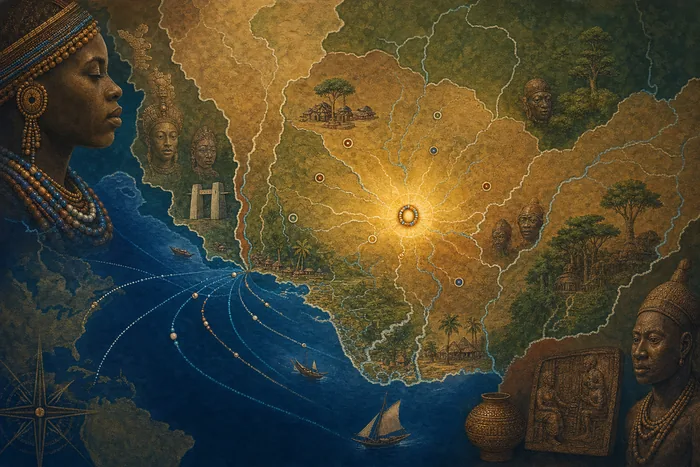
To ask where the Yoruba come from is to enter a wide courtyard of memory. At the centre stands Ile-Ife, honoured in many Yoruba traditions as a sacred source of civilisation and kingship. Beside it stands Oduduwa, a foundational figure remembered in different ways: ancestor, king, culture hero, sacred being, and dynastic source. But Yoruba origins are not only a single royal story. They also live in language history, ancient cities, sculpture, glass beads, Oyo political power, local identities, and Atlantic diaspora survival. This visual story follows those layers carefully — respecting tradition while showing what scholarship, archaeology, and living culture can tell us.
Begin at Ile-Ife
Many Yoruba traditions remember Ile-Ife as a sacred beginning point — a place where the world, civilisation, kingship, or organised Yoruba life took root. It is not just a dot on a map; it is a centre of memory, ritual authority, and artistic achievement.
Scholarly and museum sources describe Ife as an early and influential urban centre, with major religious-political importance and celebrated art traditions. For readers, the careful phrasing matters: tradition gives Ile-Ife sacred meaning; archaeology confirms its historical importance, but does not prove every sacred claim literally.
Oduduwa: One Figure, Many Meanings
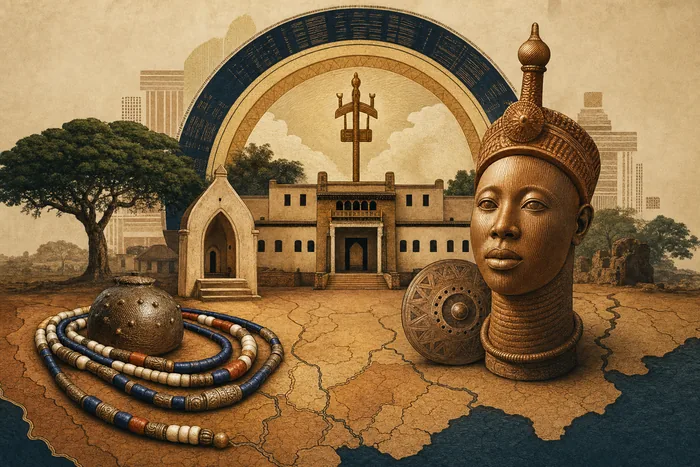
In many accounts, Oduduwa stands at the beginning of Yoruba dynastic memory. Some traditions remember Oduduwa as a founder or first king; others as an ancestor, sacred figure, or culture hero linked to Ile-Ife.
The details vary across communities and historical writings. Scholars also note that Oduduwa descent traditions have helped explain royal legitimacy and relationships among Yoruba polities. So Oduduwa should not be reduced to a modern biography with one fixed interpretation.
Not Every Origin Claim Says the Same Thing
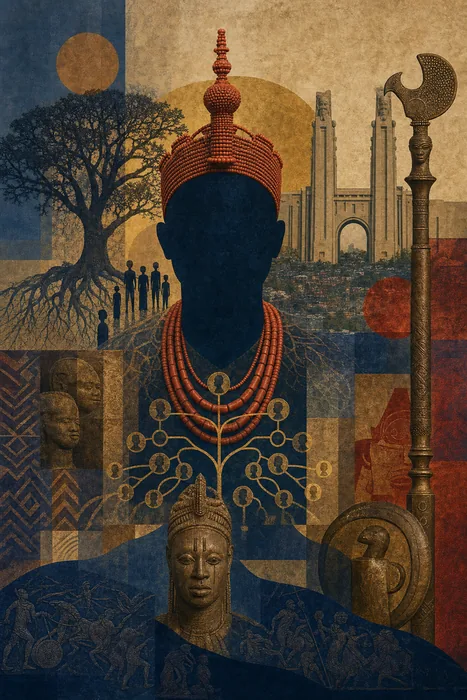
Some recorded traditions speak of Oduduwa or Yoruba ancestors coming from the “East,” Mecca, Arabia, Egypt, or Israel. These stories are part of the historical record of how people narrated identity — but they remain contested.
Many scholars treat these eastern-origin accounts cautiously, especially where they may reflect later religious, political, or prestige genealogies. A careful visual story should show them as traditions, not as settled proof that Yoruba civilisation came from outside West Africa.

Language Points to Deep West African Connections
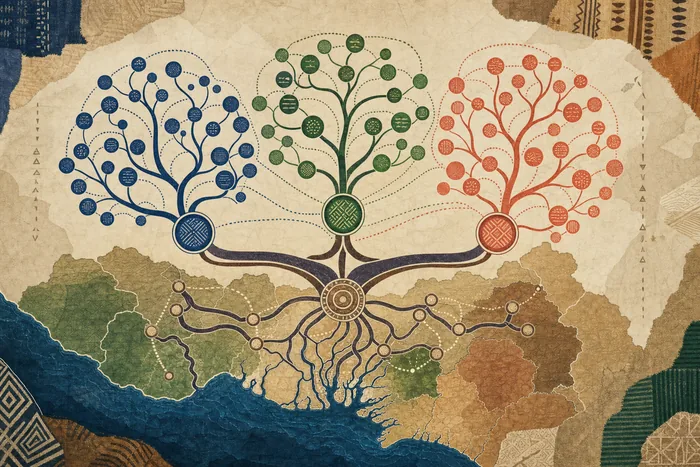
Yoruba belongs to the Yoruboid branch of the Niger-Congo language family. It is related to languages such as Igala and Itsekiri, pointing to long regional histories of language development, contact, and shared roots.
Language evidence does not mean these peoples are the same, and it should not be used to claim ownership of one identity by another. But it does place Yoruba firmly within West African linguistic history — an important balance to external-origin-only stories.
Ife Was Also a City of Makers
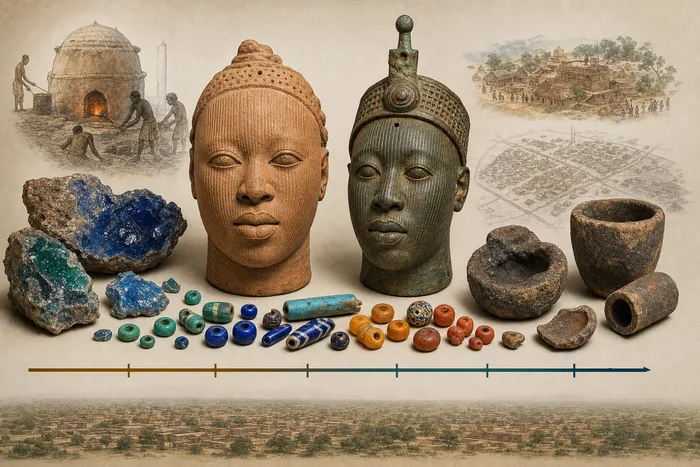
Beyond sacred memory, Ile-Ife was a place of extraordinary craft and technology. It is known for naturalistic terracotta and copper-alloy sculpture, as well as evidence of glass and glass-bead production at Igbo Olokun.
Excavations at Igbo Olokun indicate significant local glass production from around the 11th century CE. This helps shift the story from “Where did they come from?” to “What did Yoruba centres build, make, trade, and imagine?”
Before Oduduwa, There Were Earlier Layers
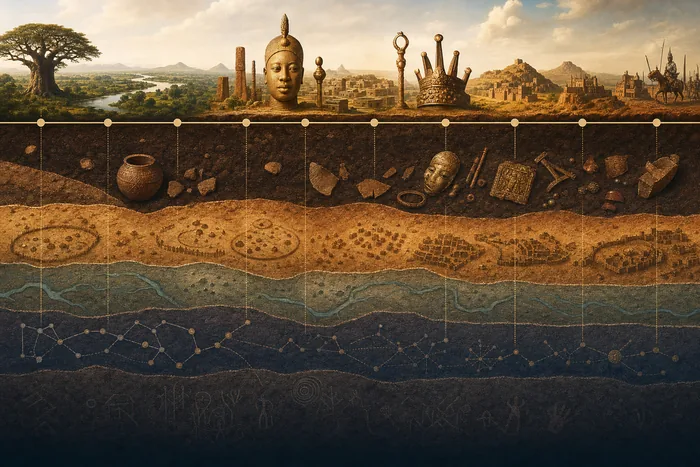
Oduduwa traditions mark a powerful beginning in Yoruba memory, but scholars also point to older layers of settlement, language, and culture before the dynastic stories became dominant.
The period before the classical Ife and Oduduwa-centred traditions is not fully reconstructed. That uncertainty is important: Yoruba history should not be forced into either a purely mythical beginning or a single migration line.
Ife and Oyo Played Different Roles
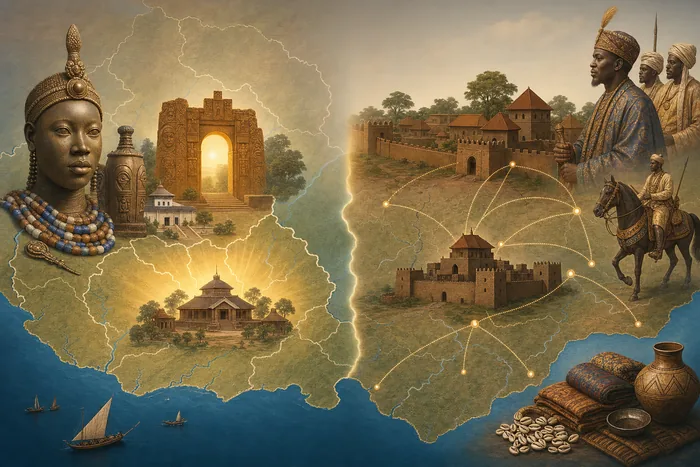
Ile-Ife is central to sacred origin and dynastic memory. Oyo, which emerged later, became one of the most powerful Yoruba states and a major force in regional politics, warfare, trade, and diplomacy.
Traditions link Oyo’s royal origin to Oduduwa through descendants associated with Ile-Ife, but Oyo should not be treated as the origin of all Yoruba people. It is better understood as a major later political centre within a wider Yoruba world.
Yoruba Was Also Many Local Names
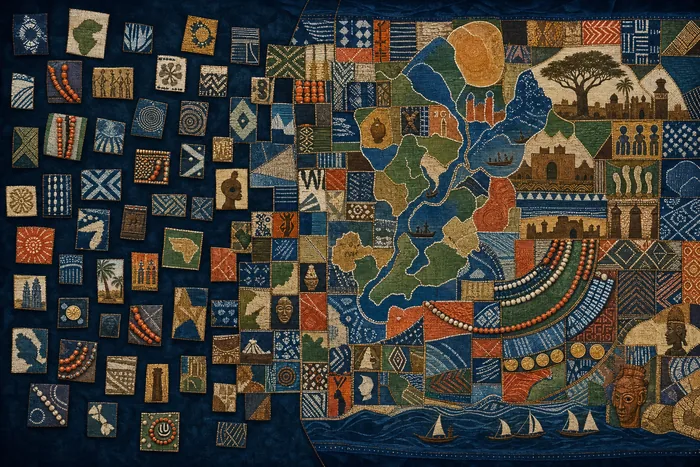
The broad identity now called Yoruba developed across many towns, regions, kingdoms, dialects, and communities. Older and contextual labels include Oyo, Ekiti, Ijebu, Nago or Anago, Aku, and Lucumi.
This does not mean there was no shared culture before modern times. It means that collective identity expanded and became more standardised through history — including missionary writing, print culture, colonial-era scholarship, politics, and self-definition.
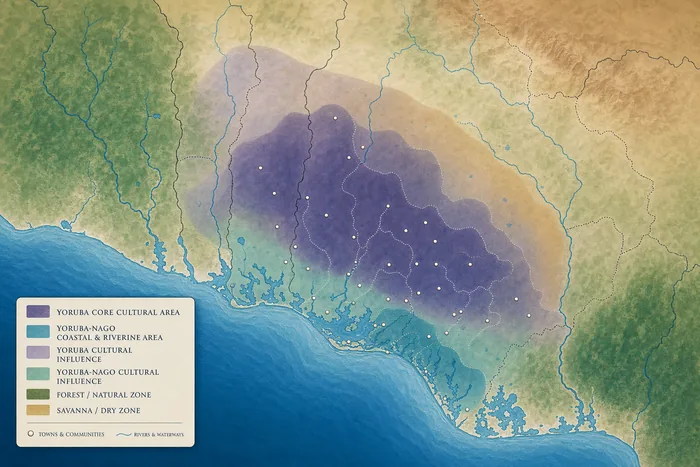
Borders Came Later Than Culture Zones
Today, Yoruba people are concentrated mainly in southwestern Nigeria, with related Yoruba-Nago communities in Benin and Togo. Modern national borders do not fully capture older cultural and linguistic geographies.
A good map should use soft cultural shading, not hard ethnic walls. It should show towns, regions, and border-crossing communities while remembering that identities are lived locally and historically.
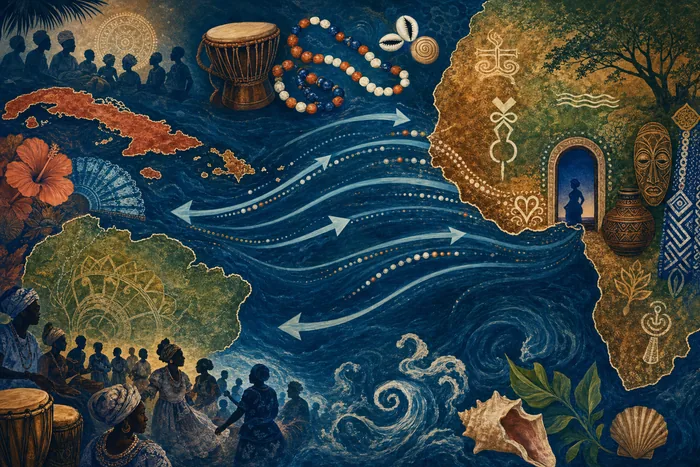
The Atlantic Carried Yoruba Memory Far
During the Atlantic slavery era, Yoruba-speaking captives and their descendants carried language, names, ritual knowledge, music, and orisha traditions into the Americas. In Cuba, Brazil, and elsewhere, these memories became part of new diaspora religions and cultural worlds.
Lucumi or Santeria in Cuba and Yoruba-influenced Candomble in Brazil are not simple copies of Yoruba religion. They formed under enslavement, adaptation, Catholic contexts, and contact with other African traditions. Still, they show how Yoruba heritage survived, changed, and spoke across the ocean.
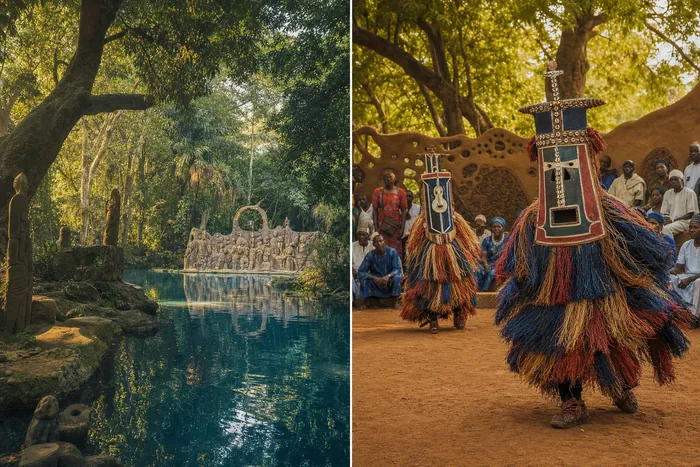
Living Heritage: Grove, Mask, River, Ritual
Yoruba origins are not locked in the past. The Osun-Osogbo Sacred Grove remains a living sacred landscape, while Gelede among Yoruba-Nago communities in Benin, Nigeria, and Togo shows how performance can carry social, spiritual, and historical meaning.
These traditions should not be treated as tourist spectacle alone. Sacred groves, masquerade, festival, and ritual performance are part of living communities, with protocols, meanings, and changing modern contexts.
Key Takeaways
- Ile-Ife is central in many Yoruba origin traditions and is also strongly supported as a major early historical, artistic, and religious-political centre.
- Oduduwa is a foundational Yoruba figure, but traditions remember Oduduwa in different ways; the story should not be flattened into one modern biography.
- Middle Eastern or eastern-origin claims exist in some accounts, but they are contested and should not be treated as settled historical proof.
- Linguistic evidence places Yoruba within deep West African language history, especially through the Yoruboid branch of Niger-Congo.
- Yoruba identity developed through many local histories, towns, kingdoms, dialects, and names — not through one simple origin line.
- Yoruba heritage extends beyond Nigeria into Benin, Togo, and the Atlantic diaspora, where traditions survived and transformed.
What To Watch
Future Yoruba-origin research will keep paying attention to local community histories beyond the Ile-Ife master narrative, archaeology from earlier settlement layers, careful study of Oduduwa traditions, and how younger Yoruba people in Nigeria, Benin, Togo, and the diaspora continue to carry identity through language, religion, art, festivals, and digital culture.
Sources
- Yoruba | History, Language & Religion - Encyclopaedia Britannica, 2026
- Ife (from ca. 6th Century) - The Metropolitan Museum of Art, Heilbrunn Timeline of Art History, 2000; revised 2014
- Geography and Society, in The Yoruba from Prehistory to the Present - Cambridge University Press, 2019
- The Heritage of Oduduwa: Traditional History and Political Propaganda among the Yoruba - The Journal of African History / Cambridge Core, 1973
- Samuel Johnson’s View about Oduduwa in Connection with the Origins of the Yoruba - HTS Teologiese Studies / Theological Studies, 2020
- Yoruboid Languages - Encyclopaedia Britannica, Not listed
- Ile-Ife and Igbo Olokun in the History of Glass in West Africa - Antiquity / Cambridge Core, 2017
- Osun-Osogbo Sacred Grove - UNESCO World Heritage Centre, 2005 inscription; page current
- Oral Heritage of Gelede - UNESCO Intangible Cultural Heritage, 2008 inscription on Representative List
- Olowe of Ise: A Yoruba Sculptor to Kings - Smithsonian National Museum of African Art, 1998 exhibition material
- Oyo Empire | History, Definition, Map, & Facts - Encyclopaedia Britannica, Not listed; page current
- The Body in Yoruba: A Linguistic Study - Max Planck Institute repository, 2006
- Reflection on the Theory of the Arab Origin of the Yoruba People - Theologia Viatorum, 2019
- Yoruba Ethnic Groups or a Yoruba Ethnic Group? A Review of the Problem of Ethnic Identification - África: Revista do Centro de Estudos Africanos, Universidade de São Paulo, 1982
- Nigerian Treasures: Ife Heads - National Geographic History, 2021
- Nigeria: History - Encyclopaedia Britannica, 2026
- Orisha | African Deities, Rituals & Beliefs - Encyclopaedia Britannica, 2026
- Santeria | Definition, Meaning, History, & Facts - Encyclopaedia Britannica, 2026
- Candomble - Encyclopedia.com / Encyclopedia of Latin American History and Culture, 2018
More in Nigeria Ethnic Origins
More Summaries
- Top Sports Videos
- Top Music Videos
- Top Entertainment Videos
- Nigeria Festivals A recurring monthly review/tracker of top festivals and cultural events in Nigeria
- Nigeria Sports Stars Timely analysis articles about Nigerian sports stars across all sports, with special depth for...
- Geopolitical Conflict Deep Dive Source-backed deep dives into major geopolitical conflict developments, explaining what happened,...
- News Summaries Nigeria News Summaries is your go-to digest for the latest headlines from Nigeria and beyond. We...