Discover.
Entertain. Live. Asorock
Israel’s Forward-Defense Doctrine Raises Pressure on Turkey and Saudi Arabia
Netanyahu’s pledge to initiate, attack, and hold security zones across Gaza, Lebanon, and Syria is sharpening a collision between Israel’s security policy and the interests of two key Western security partners.
Benjamin Netanyahu’s June 2026 JNS International Policy Summit address gave explicit political language to a pattern already visible on several fronts: Israel says it will move first, attack threats before they mature, and maintain security zones in Gaza, southern Lebanon, and southern Syria for as long as it deems necessary. Israel frames this as a lesson of October 7 and a requirement for civilian protection. Turkey, Saudi Arabia, Lebanon, Syria, UN actors, and humanitarian agencies see a different risk: open-ended territorial control, blocked civilian returns, sovereignty violations, and wider regional instability. For Western governments, especially the United States, the doctrine complicates relations with Turkey, a NATO ally, and Saudi Arabia, a major non-NATO ally whose potential normalization with Israel remains tied to Gaza withdrawal, Palestinian statehood, and Arab sovereignty concerns.
Key Takeaways
- Netanyahu publicly described a changed Israeli doctrine built around initiative, attack, surprise, and neutralizing threats before they can strike Israel.
- Israel says its security zones in Gaza, Syria, and Lebanon are defensive and will remain as long as needed; critics frame them as occupation, expansion, and sovereignty violations.
- Turkey’s opposition is amplified by its NATO status, its role in Syria, and its stated interest in future Lebanon security arrangements after UNIFIL.
- Saudi Arabia’s path toward normalization with Israel becomes harder while Israeli military control, Gaza displacement concerns, and incursions into Syria remain visible.
- The United States faces a triangular strain: supporting Israel’s security while managing Turkish and Saudi objections to Israeli territorial policies.
- The central uncertainty is whether the security zones remain temporary military buffers, become bargaining leverage, or harden into open-ended conflict lines.
A doctrine meant to create depth for Israel is creating diplomatic depth for the crisis
Israel’s post-October 7 security posture is no longer only about defeating specific armed groups. Netanyahu has articulated a broader approach in which Israel acts preemptively and holds forward zones across borders until threats are removed. That may reduce some immediate risks for Israel, but it also moves the dispute into questions of sovereignty, occupation, civilian return, humanitarian access, and regional order. Turkey and Saudi Arabia can remain Western-aligned security partners while opposing this Israeli policy, creating a more fragmented U.S.-aligned camp in the Middle East.
Netanyahu turns battlefield practice into a declared doctrine
The JNS address made explicit that Israel’s leadership now favors preemption, initiative, and open-ended forward security zones over older assumptions about containment and deterrence.
At the 2026 JNS International Policy Summit, Netanyahu said Israel had changed its security doctrine, using the formulation: “We initiate. We attack. We surprise.” He said Israel attacks enemies before they have a chance to attack Israel. In the same address, he said Israel had established security zones in Gaza, Syria, and Lebanon and would keep them “as long as is necessary” to protect Israelis.
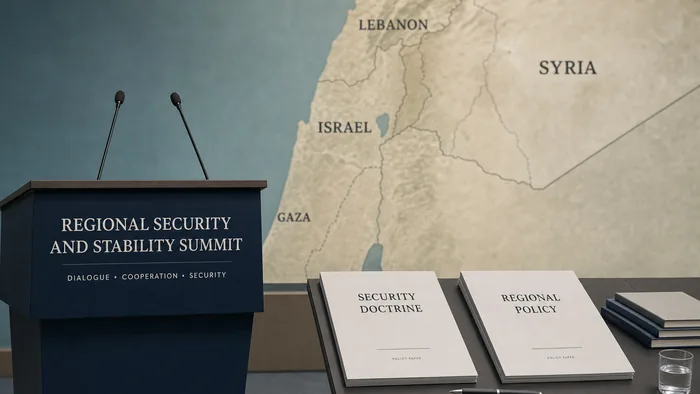
The speech matters because it links several separate fronts into one strategic logic. Israel is not only describing operations against specific armed actors; it is defending an open-ended policy of cross-border security depth. That makes the doctrine a regional issue, not only an Israeli domestic or Israel-Palestine issue.
The doctrine gives Israel a clear rationale for remaining forward in contested areas, but it also gives critics a clear target. Turkey, Saudi Arabia, Lebanon, Syria, and UN actors can point to the same language as evidence that temporary military action may become a longer-term territorial arrangement.
The key test is whether Israeli officials define measurable conditions for withdrawal from Gaza, southern Lebanon, and southern Syria, or whether the phrase “as long as necessary” remains the controlling standard. Watch also whether Israeli domestic politics, especially pressure from security-focused constituencies or territorial activists, makes future withdrawals harder.
Security zones in Lebanon and Syria turn doctrine into a sovereignty dispute
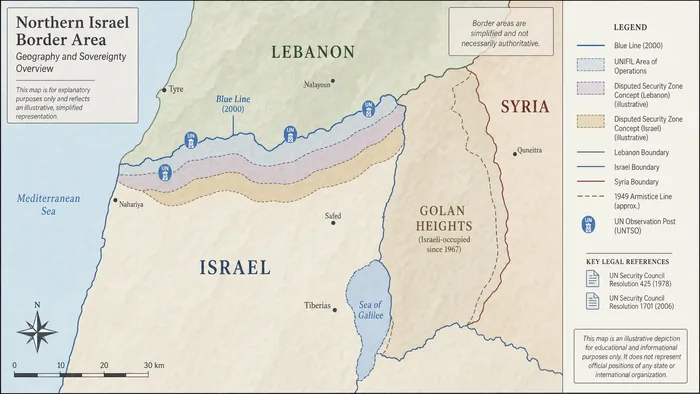
Israel frames its positions in southern Lebanon and southern Syria as defensive buffers, while UNIFIL, Lebanon, Syria, Turkey, and Saudi Arabia frame them through sovereignty and legality.
Reuters reported that Israeli officials denied any withdrawal from the southern Lebanon buffer zone after a U.S. official said Israel had pulled back from part of it. Reuters described the zone as about 10 km, or 6 miles, into Lebanon from the Israeli border. Earlier, Reuters reported that Israel told residents in parts of southern Lebanon not to return and published maps showing an Israeli deployment line 5-10 km inside Lebanon. UNIFIL later said Israel’s self-declared “Yellow Line” lies about 5-10 km north of the Blue Line and is not recognized by the United Nations. In Syria, AP reported that Israel’s military has occupied an area in the south for more than a year, while fringe Israeli settler activists have tried to enter southern Syria to claim land for a Jewish outpost; the Israeli military says such activists compromise operations and are detained when caught crossing.
These zones are the practical expression of the new doctrine. For Israel, they are meant to keep hostile forces away from Israeli communities. For Lebanon, Syria, the UN, Turkey, and Saudi Arabia, they raise the question of whether a state can unilaterally hold land beyond recognized lines for an undefined period.
The longer these zones remain in place, the more they risk becoming recurring flashpoints. Armed actors can use occupation narratives to justify continued resistance, while Israel can cite continued armed resistance as a reason to remain. This creates a cycle in which withdrawal, disarmament, and sovereignty restoration become mutually dependent and difficult to sequence.
Watch for any U.S.-mediated proposal that transfers security responsibilities in southern Lebanon to Lebanese state forces, and for whether Israel accepts such arrangements as sufficient. In Syria, watch whether Israeli military control remains separate from fringe settler activism, because any perceived link between security zones and settlement ambitions would deepen regional distrust.
Turkey is likely to treat Israel’s posture as a regional-order challenge
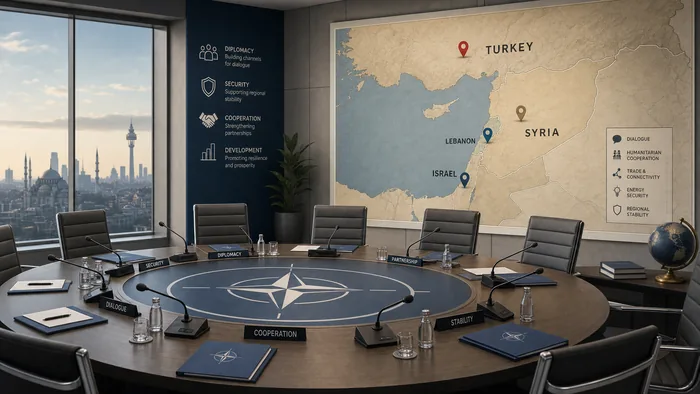
Ankara’s response is shaped by its NATO role, its influence in Syria, its interest in Lebanon, and its public framing of Israeli policy as occupation and displacement.
Turkey’s Foreign Ministry condemned what it called Israel’s expanding occupation in Lebanon and accused the Netanyahu government of seeking, as in Gaza, to make occupied areas uninhabitable and force permanent displacement. Turkey has also signaled interest in joining a new security initiative for Lebanon after UNIFIL’s mandate ends, with President Recep Tayyip Erdogan saying Turkey wants to support security in the region and Lebanon’s sovereignty.
Turkey is not an outside observer. It is a NATO member, hosted the July 2026 NATO Summit in Ankara, and is an influential actor in Syria. Israeli positions in Syria and Lebanon therefore intersect with Turkish regional influence, Turkish domestic politics, refugee concerns, and Ankara’s wider contest over the postwar security architecture of the Levant.
Deeper Israel-Turkey hostility complicates Western coalition management. Western governments may want Turkey’s cooperation on NATO and regional stabilization while also supporting Israel’s security. If Ankara moves from condemnation to a more active role in Lebanon’s future security arrangements, Israeli-Turkish friction could become more operational and diplomatic, not just rhetorical.
Watch whether Turkey’s proposed role in a post-UNIFIL Lebanon security initiative gains legal backing, Lebanese support, or wider international sponsorship. Also watch whether Israel publicly rejects Turkish involvement, because that would turn the Lebanon file into a direct test of Turkey’s regional security ambitions and Western diplomacy.
Saudi Arabia’s normalization calculus becomes harder
Riyadh’s objections are rooted in Gaza, Palestinian statehood, anti-displacement principles, and Arab state sovereignty, including Syria.
Saudi Arabia condemned Israeli incursions into Syria and shelling of Quneitra and Daraa, calling for adherence to the 1974 Disengagement Agreement and support for Syria’s sovereignty and territorial unity. Saudi Arabia has also maintained that peace requires a ceasefire, preventing displacement, withdrawal from Gaza, and a Palestinian state on the 1967 borders. In 2024, Riyadh stated there would be no diplomatic relations with Israel without recognition of an independent Palestinian state, an end to Israeli aggression in Gaza, and withdrawal of Israeli occupation forces from Gaza.
Saudi-Israel normalization has been a major U.S. regional objective. Israel’s open-ended security zones make that objective harder because they collide with the public Saudi conditions for peace and recognition. Gaza remains central, but Israeli actions in Syria add another sovereignty issue to the Saudi objection set.
Visible Israeli entrenchment gives Riyadh less domestic, Arab, and Islamic political space to move toward recognition without major Israeli concessions. Saudi Arabia can remain a U.S. major non-NATO ally and still slow or condition normalization if Israeli policy appears to involve prolonged territorial control or displacement pressure.
Watch whether Saudi statements remain focused on Gaza and Palestinian statehood or increasingly include Lebanon and Syria as linked conditions for regional peace. Also watch whether Washington attempts to separate normalization talks from Israeli buffer-zone policy, or whether Riyadh insists that withdrawal, sovereignty, and anti-displacement commitments remain part of any diplomatic package.
Washington faces a partner-management problem
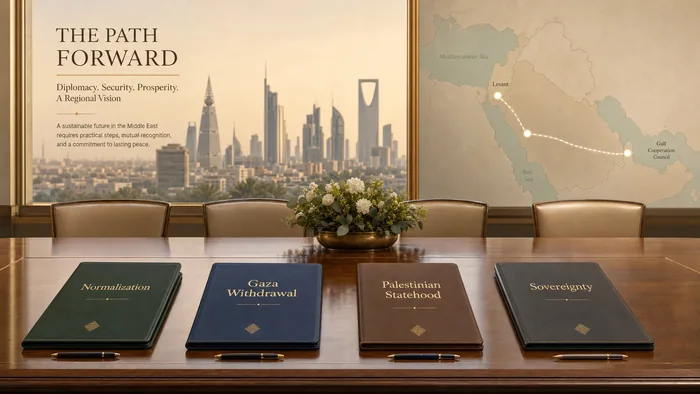
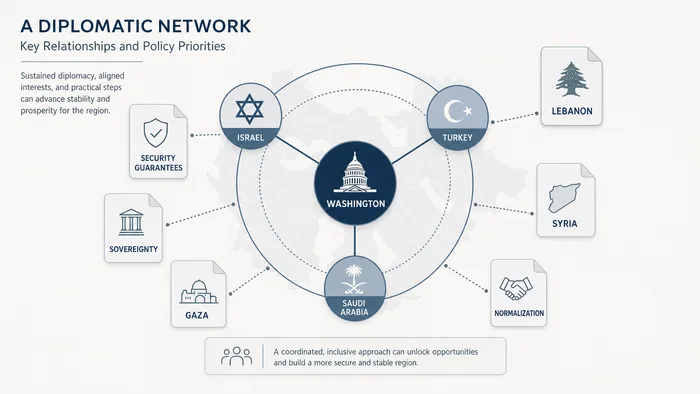
Israel, Turkey, and Saudi Arabia all matter to U.S. strategy, but their security preferences are increasingly colliding across Gaza, Lebanon, and Syria.
The United States is Israel’s key ally and has also been involved in Israel-Lebanon proposals around handover of parts of southern Lebanon to Lebanese authority. At the same time, Turkey remains a NATO member, and Saudi Arabia was designated by the United States as a major non-NATO ally in January 2026.
The issue is no longer limited to U.S. support for Israel or to the Israeli-Palestinian conflict. Washington must manage an Israeli doctrine that seeks forward security depth, a Turkish ally condemning that posture and seeking a role in Lebanon, and a Saudi partner whose normalization position is constrained by Gaza, Palestinian statehood, and Arab sovereignty concerns.
This can produce a more transactional regional alignment. Turkey and Saudi Arabia may continue cooperating with the West on some security files while resisting Israeli territorial policies. That weakens any simple picture of a unified pro-Western regional bloc aligned behind Israel’s military approach.
Watch U.S. mediation language on Lebanon, especially whether Washington emphasizes Israeli security guarantees, Lebanese sovereignty, or both. Also watch whether U.S.-Saudi diplomacy gives Riyadh assurances on Palestinian statehood, Gaza withdrawal, or Syrian sovereignty sufficient to keep normalization discussions alive.
Humanitarian harm and legal objections shape the regional backlash
Displacement, damaged infrastructure, blocked returns, and UN legal framing are central to how Turkey and Saudi Arabia oppose Israel’s doctrine.
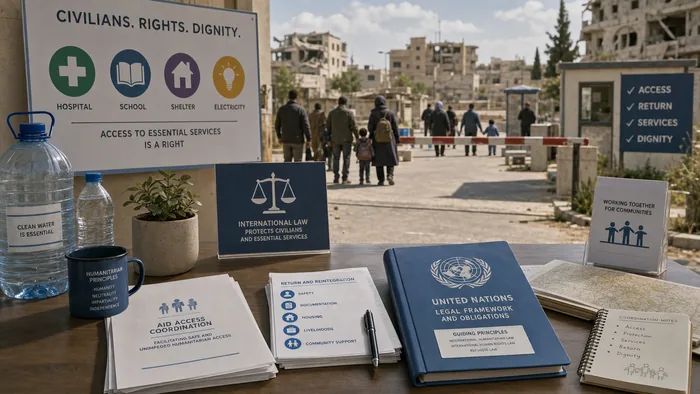
OCHA reported that in Gaza, ongoing military operations, movement restrictions, and insecurity are driving new displacement and limiting access to food, water, shelter, health care, and other essential services. UNIFIL reported that many displaced families returning to southern Lebanon face destroyed villages, damaged infrastructure, and limited access to water, electricity, hospitals, and schools, while some villages close to the Blue Line remain inaccessible because of insecurity. UNIFIL also said Israeli presence north of the Blue Line violates Security Council Resolution 1701.
Israel presents forward security zones as protection for Israeli civilians. Turkey, Saudi Arabia, UNIFIL, and humanitarian reporting emphasize the effects on Palestinians, Lebanese civilians, and Syrians: displacement, access restrictions, damaged services, and sovereignty violations. These competing civilian-protection claims are central to the diplomatic dispute.
Humanitarian deterioration can generate political backlash across Arab and Muslim publics, narrowing the room for Turkey and Saudi Arabia to cooperate openly with Israel. Legal objections also give regional governments a framework for opposing the zones without relying only on political rhetoric.
Watch whether civilian returns in southern Lebanon become possible at scale, whether Gaza access restrictions ease, and whether UN bodies continue to frame Israeli positions north of the Blue Line as violations. Humanitarian access and civilian return conditions will strongly influence whether the doctrine is seen internationally as defensive security management or open-ended occupation.
Key Events
-
April 9, 2026
Reuters analysis described Israel’s buffer zones in Gaza, Syria, and Lebanon as a strategic shift after October 7, 2023 that could place Israel in a semi-permanent state of war.
This framed Israel’s forward-defense posture as more than temporary battlefield maneuvering.
-
April 19-20, 2026
The Israeli military published maps of a new deployment line inside Lebanon and told residents not to enter areas between the line and the border.
The map made Israel’s southern Lebanon buffer more visible and sharpened Lebanese, UN, and regional objections.
-
June 1, 2026
Turkey condemned what it called Israel’s expanding occupation in Lebanon.
Ankara cast Israel’s southern Lebanon posture as expansionist and linked it to displacement concerns.
-
June 21-22, 2026
Netanyahu’s JNS speech explicitly linked Israel’s changed security doctrine to security zones in Gaza, Syria, and Lebanon.
The speech turned a pattern of military operations into an articulated political doctrine.
-
June 25, 2026
Reuters reported Israeli and Lebanese denials after a U.S. official said Israel had pulled back from part of the southern Lebanon buffer zone.
The incident showed the sensitivity of withdrawal claims and the difficulty of reconciling Israeli security demands with Lebanese sovereignty.
-
June 29, 2026
Saudi Arabia condemned Israeli incursions into Syria and shelling in Quneitra and Daraa.
Riyadh’s response showed that Israeli actions in Syria, not only Gaza, are now part of the normalization obstacle set.
-
July 2026
UNIFIL said the Israeli “Yellow Line” buffer zone in southern Lebanon is not recognized by the UN and that Israeli presence north of the Blue Line violates Resolution 1701.
The UN position gives Lebanon, Turkey, Saudi Arabia, and other critics a legal and diplomatic framework for rejecting Israeli buffer-zone permanence.
-
July 29, 2026
AP reported increased attempts by fringe Israeli settler activists to enter southern Syria and claim land for a Jewish outpost, while Israel’s military condemned the activity.
Even if fringe, settler activism raises fears that temporary military buffers could become politicized territorial projects.
-
July 30, 2026
Erdogan said Turkey wants to participate in any future initiative to support Lebanon’s security and sovereignty after UNIFIL.
Turkey is positioning itself not just as a critic of Israel but as a potential security stakeholder in Lebanon’s postwar architecture.
Watchlist
Israeli withdrawal criteria
The distinction between temporary security zones and open-ended territorial control depends on whether Israel defines clear, verifiable conditions for leaving Gaza, southern Lebanon, and southern Syria.
Watch for Israeli statements tying withdrawal to specific security milestones, handover to state forces, or disarmament arrangements. If the language remains only “as long as necessary,” regional governments are likely to treat the zones as open-ended.
Turkey’s potential role in Lebanon security arrangements
A Turkish role after UNIFIL would move Ankara from critic to participant in the security architecture around Israel’s northern front.
Watch for Lebanese approval, international mandate language, U.S. or European support, and Israeli reaction. A clear Israeli rejection of Turkish involvement would add a direct Israel-Turkey layer to the Lebanon file.
Saudi normalization conditions
Saudi Arabia remains central to U.S. regional diplomacy, but Israeli buffer-zone policy increases the political cost of recognition.
Watch whether Riyadh maintains its existing focus on Gaza withdrawal, preventing displacement, and Palestinian statehood, or whether it more explicitly links normalization to Israeli actions in Syria and Lebanon as well.
UNIFIL, Blue Line, and Resolution 1701 diplomacy
UNIFIL’s legal framing gives Lebanon and regional critics a basis for rejecting Israeli positions north of the Blue Line.
Watch for UN statements on the Yellow Line, any Security Council debate, and whether proposals for Lebanese Armed Forces deployment can satisfy both sovereignty demands and Israeli security concerns.
Humanitarian access and civilian return
Conditions for Palestinians in Gaza and Lebanese civilians in the south will shape regional public pressure on Turkey, Saudi Arabia, and Western governments.
Watch OCHA and UNIFIL reporting on displacement, access to food, water, shelter, health care, schools, electricity, and the ability of civilians to return safely to areas near military exclusion lines.
Fringe settler activism near security zones
Even if not official policy, settler attempts to enter southern Syria or other frontier areas can blur the line between military security buffers and ideological territorial claims.
Watch whether the Israeli military continues detaining such activists and whether any Israeli political figures give them public support. Direct state authorization would materially change the analysis and should not be assumed without evidence.
Related Reading
- How Israel’s buffer zones in Gaza, Lebanon, and Syria changed after October 7
- Why Saudi-Israel normalization remains tied to Gaza and Palestinian statehood
- Turkey’s role in Syria and Lebanon after the latest regional escalation
- What UNIFIL and Resolution 1701 mean for southern Lebanon
- How humanitarian access shapes Middle East diplomacy
Sources
- IN FULL: Israeli Prime Minister Benjamin Netanyahu’s address to the JNS International Policy Summit 2026 - JNS, June 22, 2026
- Israel, Lebanon deny US claim that Israel has withdrawn from part of southern Lebanon - Reuters via MarketScreener, June 25, 2026
- Israel entrenches hold on south Lebanon; US to host talks on Thursday - Reuters via Investing.com, April 20, 2026
- Israeli military publishes map of south Lebanon territory under its control - Reuters via Investing.com, April 19, 2026
- Update on the situation in the South of Lebanon from UNIFIL - UN Geneva / UNIFIL, July 2026
- Fringe Israeli settler group seeks to establish a Jewish settlement in southern Syria - Associated Press, July 29, 2026
- No: 104, 1 June 2026, Regarding Israel’s Expanding Occupation in Lebanon - Republic of Türkiye Ministry of Foreign Affairs, June 1, 2026
- Turkey wants to join a new Lebanon security initiative after UN mission ends - Associated Press, July 30, 2026
- Saudi Arabia Condemns Israeli Incursions into Syria, Targeting of Quneitra and Daraa - Saudi Press Agency, June 29, 2026
- Saudi Arabia Affirms Peace Requires Ceasefire, Preventing Displacement, Establishing Palestinian State on 1967 Borders - Saudi Press Agency, April 29, 2026
- The Ministry of Foreign Affairs states the discussions between the Kingdom of Saudi Arabia and the United States of America on the Arab-Israeli peace process - Saudi Ministry of Foreign Affairs, February 7, 2024; page modified February 12, 2024
- Presidential Determination on Designation of the Kingdom of Saudi Arabia as a Major Non-NATO Ally - U.S. Government Publishing Office / Office of the Federal Register, January 13, 2026
- Overview - 2026 NATO Summit in Ankara - NATO, July 2026
- Humanitarian Situation Report | 16 July 2026 - United Nations Office for the Coordination of Humanitarian Affairs - Occupied Palestinian Territory, July 16, 2026
- As US and Iran talk truce, Israel digs in for a 'forever war' - Reuters via MarketScreener, April 9, 2026
More in Geopolitical Conflict Deep Dive
-
Israel’s Forward-Defense Doctrine Raises Pressure on Turkey and Saudi ArabiaAugust 1
-
Nigeria’s Search for an Arms Industry That Can LastJuly 1
-
U.S.-Iran Strikes and Israel-Lebanon Fighting Put Middle East Ceasefires Under Severe StrainJune 10
-
Nigeria and U.S. Say Senior ISIS-Linked Figure Killed in Borno OperationMay 18
More Summaries
- Top Sports Videos
- Top Music Videos
- Top Entertainment Videos
- Nigeria Ethnic Origins Source-backed Visual Stories explaining Nigerian ethnic groups, origins, migration accounts,...
- Nigeria Festivals A recurring monthly review/tracker of top festivals and cultural events in Nigeria
- Nigeria Sports Stars Timely analysis articles about Nigerian sports stars across all sports, with special depth for...
- News Summaries Nigeria News Summaries is your go-to digest for the latest headlines from Nigeria and beyond. We...