Discover.
Entertain. Live. Asorock
Nigeria’s Search for an Arms Industry That Can Last
DICON has returned as the legal anchor of Nigeria’s defence-industrial policy, but the clearest practical momentum is now in ammunition plans, protected mobility, patrol boats, refurbishment and private firms such as Proforce and EPAIL/EPRIL.
Nigeria’s arms-industry debate is no longer only about the Defence Industries Corporation of Nigeria’s legacy ordnance factories. DICON began in 1964 as a state-backed manufacturing project, expanded sharply under civil-war pressure, then lost momentum after postwar demand collapsed and some equipment was redirected toward civilian products. Its reemergence is real at the institutional level: the 2023 DICON Act gives it a wider role in licensing, procurement, research funding, subsidiaries and partnerships, while recent agreements cover ammunition production and Ezugwu MRAP vehicles. But its operational comeback remains uneven and still has to be proved through certified production, delivery and field performance. The more visible shift is the rise of private protected-mobility firms, especially Proforce Group Limited and EPAIL/EPRIL. Their products, including Proforce PF ARA/Thunder MRAP, PF Viper, PF Hulk, PF Fury, PF Wizard/PF-2 APC, and EPAIL’s Mengshi/CSK-131-derived light tactical armoured vehicles and EPV24NG003 anti-mine armoured protective vehicle, have broadened Nigeria’s local supply options. Public evidence is thinner on whether these systems have measurably changed battlefield outcomes. The central policy question is whether Nigeria can turn crisis-driven production into a disciplined industrial ecosystem without procurement opacity, weak quality control, unclear local-content claims or export-control gaps.
Key Takeaways
- DICON’s arc is clearer when divided into four phases: 1964 foundation, civil-war production surge, post-1970 decline and post-2023 institutional reemergence.
- DICON has reemerged as the legal and policy anchor of Nigeria’s defence-industrial agenda, but its manufacturing comeback remains uneven until certified output, deliveries and field performance are publicly demonstrated.
- The Boko Haram and ISWAP insurgencies exposed practical gaps that local industry could not yet meet at scale: ammunition, protected vehicles, repair capacity, spare parts, surveillance, communications and faster procurement.
- Private firms are now central, not peripheral. Proforce and EPAIL/EPRIL are among the most visible actors in protected mobility, ballistic protection, armoured vehicles and security equipment.
- Named products matter because they show where Nigeria’s current capacity is most realistic: Proforce PF ARA/Thunder MRAP, PF Viper, PF Hulk, PF Fury, PF Wizard/PF-2 APC; EPAIL Mengshi/CSK-131-derived light tactical armoured vehicles and EPV24NG003; DICON/CED Ezugwu MRAPs; Buffalo APCs; bulletproof glass; spare parts; and patrol boats.
- The strongest evidence-backed impact claim is that local producers have widened Nigeria’s protected-mobility and sustainment options; it is not yet supported to claim they have decisively changed counterinsurgency outcomes.
- Nigeria remains dependent on imported major arms, and the public-interest test is whether local production is governed by transparent procurement, credible testing, end-user controls and clear local-content standards.
Nigeria is trying to rebuild defence production around practical readiness, not only sovereignty rhetoric
Nigeria’s security pressures have made local defence production a practical concern. Armed forces and security agencies need ammunition, spare parts, armoured vehicles, repair capacity, patrol craft, surveillance tools and protected mobility across multiple theatres, including the North East, North West, North Central, South East and the Gulf of Guinea. DICON’s history shows both the promise and weakness of crisis-driven production: it could surge during the civil war, but it did not become a stable postwar industrial base. The 2023 DICON Act, ammunition-factory agreement, MRAP production plans and official support for private firms indicate a renewed institutional push. The evidence still points to an industry strongest in lower- and mid-complexity systems, while drones, advanced electronics, local-content transparency, quality assurance and procurement oversight remain harder tests.
DICON’s rise, decline and uneven reemergence
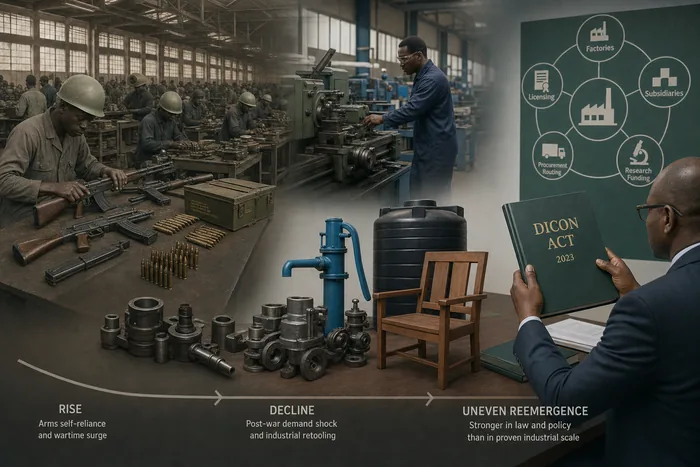
DICON was once the formal symbol of Nigerian arms self-reliance, then weakened after the civil-war demand shock ended. Its recent return is strongest in law and policy, not yet in proven industrial scale.
DICON says it was established by Act of Parliament in 1964, with West German firm Fritz Werner providing technical support and setting up the Kaduna Ordnance Factory. Its planned capacity included BM 59 rifles, SMG 12 submachine guns and millions of rounds of 7.62mm and 9mm ammunition. During the 1967-1970 civil war, DICON says production rates were tripled. After the war, however, DICON says the arms market ended and some equipment was redirected toward civilian goods such as rural water-supply equipment, industrial spare parts and furniture. The 2023 DICON Act now recasts the corporation as a broader defence-industrial anchor with powers over factories, subsidiaries, licensing, procurement routing and research funding.
This is the clearest answer to whether DICON has reemerged. Institutionally, it has: the 2023 law, ammunition agreement and MRAP production reporting put DICON back at the centre of policy. Operationally, the comeback is still incomplete because public evidence of sustained certified production, serial delivery and field performance remains limited.
DICON’s experience shows why Nigeria’s problem is not only technical. It is also about predictable demand, skilled labour, research funding, quality assurance and procurement discipline. A factory can be created by law or foreign partnership, but industrial capacity lasts only if it survives after the immediate crisis fades.
The clearest signs of a real DICON comeback would be certified production figures from DICON-linked factories, audited use of the DICON R&D Fund, delivery records for DICON/CED Ezugwu MRAPs, clear local-content definitions and evidence that production continues beyond announcements or single procurement cycles.
The Boko Haram era exposed Nigeria’s sustainment gap
Nigeria’s modern security crises turned defence production from an industrial-policy aspiration into a readiness problem involving ammunition, vehicles, repair, parts and surveillance.
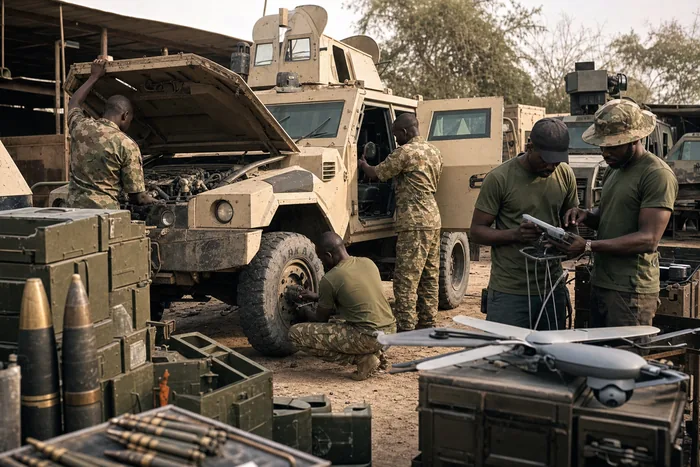
The Boko Haram and ISWAP insurgencies placed heavy pressure on Nigerian forces in the North East. The operational requirement was not limited to buying major weapons. Security forces needed dependable ammunition, mine-resistant and armoured vehicles, repair capacity, spare parts, communications, surveillance systems and faster replacement of damaged equipment. Official defence statements in 2025 also cited repair and refurbishment of MRAPs, tanks and APCs, as well as development of Buffalo APCs, MRAPs, bulletproof glass, spare parts and surveillance UAVs.
The insurgency showed that readiness depends on sustainment as much as platforms. A vehicle that cannot be repaired, a patrol unit without parts, or a force facing ammunition delays can lose operational tempo even if major equipment has been procured. This is why local industry matters most where it shortens supply lines and improves availability.
If local production and refurbishment improve equipment availability, they could strengthen responses to insurgency, armed criminal violence and kidnapping. But the impact should not be overstated. There is not enough public evidence to credit specific Nigerian-made vehicles with decisive changes in conflict outcomes or civilian-protection results.
The useful indicators are ammunition supply reliability, repair turnaround for MRAPs and APCs, spare-parts availability in active theatres, deployment of tested surveillance systems and operational feedback on locally supplied vehicles, especially where those measures can be tied to readiness rather than procurement claims alone.
Private firms are now central: Proforce and EPAIL/EPRIL
The biggest visible change in Nigeria’s defence-industrial landscape is the emergence of private protected-mobility and ballistic-protection firms alongside DICON.
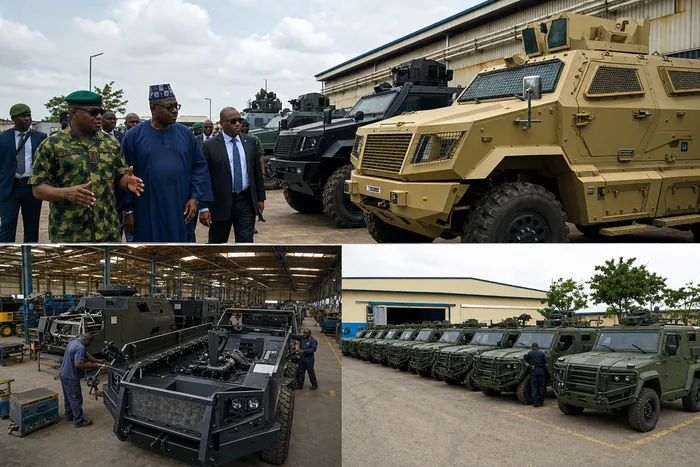
In January 2026, Nigeria’s Ministry of Defence reported visits to Equipment and Protective Applications International Limited/EPRIL and Proforce Group Limited in Ogun State. The ministry described EPRIL as an indigenous defence company producing military-operational tools and security-related equipment, and Proforce as an indigenous defence contractor specialising in armoured vehicles and security systems for land and naval applications. Proforce’s public and defence-trade materials name products including the PF ARA/Thunder MRAP, PF Viper, PF Hulk, PF Fury, PF Wizard APC and PF-2 APC. EPAIL’s public and defence-trade material refers to 20 delivered light tactical armoured vehicles and identifies Mengshi/CSK-131-derived vehicles, while EPAIL also lists the EPV24NG003 4x4 anti-mine heavy armoured protective vehicle.
These firms show that Nigeria’s defence industry is no longer only a DICON story. Proforce and EPAIL/EPRIL are operating in the area where Nigeria’s near-term industrial capacity is most plausible: protected mobility, armoured vehicles, ballistic protection, security systems and vehicle-related support. Their impact so far is best described as expanding supply options and reducing total dependence on foreign procurement for some protected-mobility needs.
Private production can support local engineering, metal fabrication, vehicle integration, materials testing and export-facing supply chains. It also raises oversight questions: what is fully manufactured locally, what is assembled from imported kits, how vehicles are tested, whether end-user checks are credible, and whether procurement rewards performance rather than political access.
The evidence to follow is whether Proforce and EPAIL/EPRIL publish or generate credible production volumes, independent ballistic and mobility testing, local-content documentation, export approvals and end-user checks, and whether official attention is followed by repeat orders backed by performance standards.
What the named products actually suggest
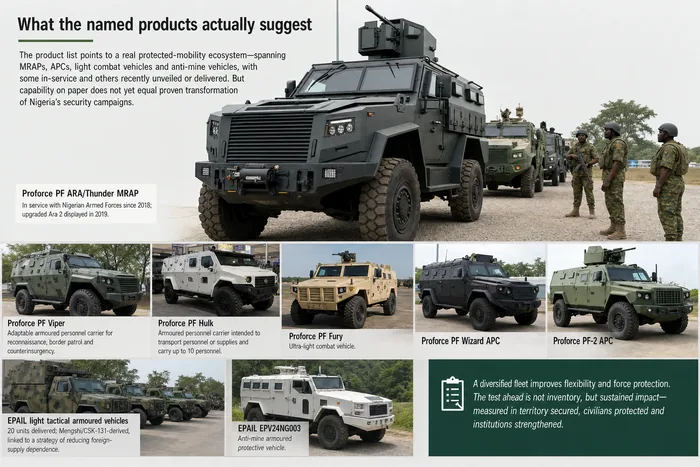
The product list points to a real protected-mobility ecosystem, but not yet to a proven transformation of Nigeria’s security campaigns.
The Proforce PF ARA/Thunder MRAP has been described in defence-trade reporting as in service with Nigerian armed forces since 2018, with an upgraded Ara 2 displayed in 2019. Proforce’s PF Viper is presented as an adaptable armoured personnel carrier for missions such as reconnaissance, border patrol and counterinsurgency. The PF Hulk, unveiled in 2024 according to Military Africa, is described as an armoured personnel carrier intended to transport personnel or supplies and carry up to 10 personnel. Military Africa has also listed PF Fury as an ultra-light combat vehicle and named PF Wizard APC and PF-2 APC within Proforce’s wider portfolio. EPAIL says it delivered 20 light tactical armoured vehicles, while Army Recognition described them as Mengshi/CSK-131-derived and linked to a strategy of reducing foreign-supply dependence. EPAIL also lists the EPV24NG003 anti-mine armoured protective vehicle.
These products matter because they answer a concrete security need: moving personnel and supplies through environments where mines, improvised explosive devices, ambushes and poor roads can shape operations. They also show that Nigeria’s private sector is active in protected mobility, not only in general security equipment. But public evidence is still limited on field performance, survivability, maintenance burden and operational outcomes.
If these vehicles perform reliably, they could reduce procurement lead times and support local maintenance. If quality control is weak or local-content claims are unclear, they could create readiness problems and procurement disputes. For EPAIL’s Mengshi/CSK-131-derived vehicles, the Chinese design origin makes local-production claims especially important to define carefully.
The main test is whether product names are matched by field-performance reports, maintenance and spare-parts data, mine and ballistic-protection testing standards, clear distinctions between assembly and manufacture, and transparent procurement records for vehicle contracts.
Ammunition, patrol boats and refurbishment are the most credible near-term gains
Nigeria’s strongest production prospects are in systems close to existing industrial capacity and continuous security demand.
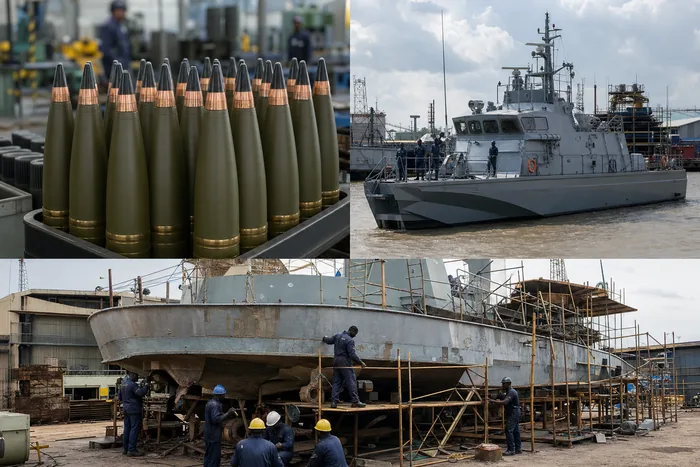
On August 13, 2024, the Ministry of Defence, DICON and NASENI signed an MoU and joint venture agreement on establishing an ammunition production factory. DICON also reported a Nigerian Army agreement with DICON and Command Engineering Depot for mass production of 28 Ezugwu MRAP vehicles, though delivery and fielding require separate verification. At sea, the Nigerian Navy’s Seaward Defence Boat programme offers a clearer example of local production: NNS Oji, commissioned in December 2021, was described by the State House as the third locally built Seaward Defence Boat constructed at Naval Dockyard Limited in Lagos, after NNS Andoni and NNS Karaduwa.
Ammunition is a realistic test because demand is constant and import dependence can become costly during security crises. Patrol boats and refurbishment are also plausible because they align with existing dockyard, engineering and maintenance capacity. These sectors are less glamorous than advanced drones or electronics, but they may matter more for day-to-day readiness.
Local ammunition, patrol craft and repair capacity could reduce foreign-exchange pressure, shorten supply chains and support industrial skills. But all three require safety standards, quality certification and predictable procurement. Ammunition production in particular carries safety and accountability obligations because defective output or poor storage can create serious risks.
The near-term indicators are completion of the ammunition line, quality certification and safety records, follow-on Seaward Defence Boat construction, verifiable delivery evidence for Ezugwu MRAPs and proof that refurbishment capacity can operate at scale rather than as isolated repair activity.
The hard tests: drones, imports, procurement and arms control
Nigeria’s defence-industrial ambitions remain constrained by inactive or unproven advanced-systems projects, continued import dependence and wider weapons-control problems.
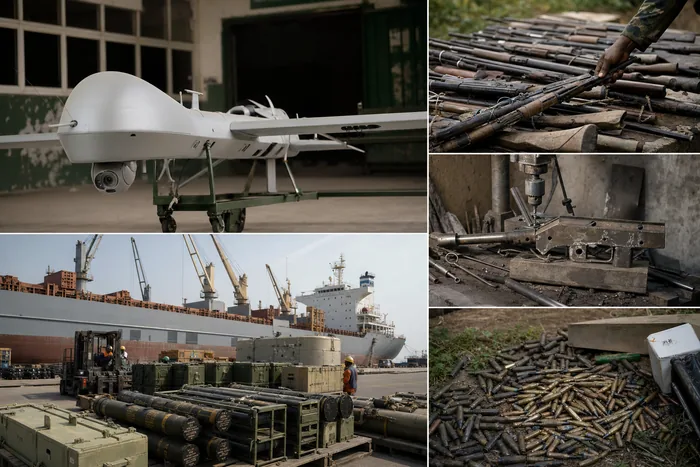
DICON reported in March 2024 that its Drone Centre, created in January 2021 with South African World Marine Technologies Systems partners to build local drone-production capacity and train drone pilots, was inactive at the time of a Director-General visit. Nigeria has continued to depend heavily on foreign suppliers for major arms: SIPRI assessed that Nigeria accounted for 34 percent of major-arms imports to West Africa in 2020-2024, making it by far the largest importer in the region. Separately, Small Arms Survey research published in 2018 found that craft-produced weapons accounted for 32 percent of firearm-related crime in Adamawa State and 69 percent in Plateau State among surveyed states, while noting that most craft producers lacked authorization.
The drone case shows that announcements and partnerships do not equal capability. The import data shows that local production remains complementary to foreign procurement, not a replacement for it. The craft-firearms issue should be kept separate from formal licensed defence manufacturing, but it remains important for public safety, tracing, enforcement and arms-control policy.
A defence industry can improve readiness, but it can also become a protected commercial constituency if procurement preference is not governed by testing, audits and competition. Export ambitions could bring revenue and regional influence, but they require end-user discipline and integrity checks. Weak arms control around informal weapons can worsen public-safety risks even if formal factories expand.
The warning signs and progress markers are activity and flight testing at the Drone Centre, serial production evidence for UAVs, major-arms import trends, procurement audits and contract transparency, and stronger marking, tracing and licensing enforcement that separates formal licensed production from illicit craft firearms.
Key Events
-
1964
DICON was established and the Kaduna Ordnance Factory was set up with Fritz Werner support.
This created Nigeria’s formal post-independence state arms industry and remains the baseline for judging later decline and revival claims.
-
1967-1970
Civil-war demand drove DICON to triple production rates, according to DICON.
The war showed that emergency pressure could force local production, but crisis output did not become a stable long-term industrial base.
-
Post-1970
DICON says the arms market ended and some equipment was used for civilian production.
This is the strongest evidence of DICON’s decline after the war: demand collapsed, continuity weakened and defence production lost momentum.
-
2018-2019
Defence-trade reporting says Proforce PF ARA/Thunder MRAP entered Nigerian armed forces service and an upgraded Ara 2 was displayed.
This marks one of the more visible examples of a Nigerian private firm entering the protected-mobility space, though operational impact remains hard to measure publicly.
-
2021-12-09
NNS Oji was commissioned as the third locally built Seaward Defence Boat.
The Navy’s patrol-boat programme shows that local production is not limited to land systems and can support maritime patrol needs at a limited scale.
-
2023
The DICON Act 2023 created a new legal framework for DICON, licensed manufacturers, procurement preference and R&D funding.
This is the strongest basis for saying DICON has institutionally reemerged, though industrial output still needs verification.
-
2024-03-26
DICON reported that its Drone Centre was inactive at the time of a Director-General visit.
The inactive centre is a warning that partnerships and launch announcements can outrun actual production capacity.
-
2024-08-13
The Ministry of Defence, DICON and NASENI signed an ammunition-factory MoU and joint venture agreement.
Ammunition is one of Nigeria’s most important near-term self-reliance tests because demand is continuous and supply disruption can affect readiness.
-
2025-06-18
Nigeria’s defence minister cited local production and refurbishment of MRAPs, tanks, APCs, Buffalo APCs, bulletproof glass, spare parts and UAVs.
The statement indicates official priorities, but its impact depends on tested products, reliable deliveries and maintenance support.
-
2026-01-28 to 2026-01-29
The Ministry of Defence visited EPAIL/EPRIL and Proforce in Ogun State.
The visit publicly confirmed that private manufacturers are now central to Nigeria’s defence-industrial push, especially in protected mobility and security systems.
-
2026
DICON reported a Nigerian Army agreement with DICON/CED for mass production of 28 Ezugwu MRAP vehicles.
This supports the argument that DICON is being repositioned in protected mobility, but delivery and fielding should be verified separately.
Watchlist
Whether DICON’s reemergence becomes industrial, not only legal
The 2023 DICON Act gives the corporation a stronger mandate, but laws and MoUs do not by themselves prove production capacity. The decisive evidence will be certified output, deliveries, audited funding and field performance.
The most important signs will be published licensing rules, R&D Fund reporting, certified production figures, delivery records and supplier quality standards that show DICON’s new mandate is producing verified capability rather than another layer of institutional authority.
Ammunition factory progress
Ammunition is one of the most realistic and strategically important areas for local production because it is consumed continuously and exposed to import delays. The test is certified output, not only factory announcements.
Progress should be judged by production-line completion, quality certification, safety record and regular deliveries, because ammunition self-reliance depends on dependable certified output rather than the existence of an agreement or factory plan.
Private-sector protected mobility
Proforce and EPAIL/EPRIL are now among the most important actors in Nigeria’s practical defence-industrial base. Their significance depends on whether named products move from catalogues, deliveries and official visits into tested, maintainable and repeatable capability.
The evidence should include production numbers, ballistic and mine-protection tests, local-content documentation, repeat procurement and export-control records that show whether private protected-mobility production is becoming a reliable capability rather than a collection of product announcements.
Product-specific field evidence
Vehicles such as PF ARA/Thunder MRAP, PF Viper, PF Hulk, EPAIL Mengshi-derived LTAVs, EPV24NG003 and Ezugwu MRAPs matter only if they perform reliably under Nigerian operating conditions. Public evidence is still limited on survivability, maintenance burden and operational impact.
The useful signals are field-performance reports, maintenance data, spare-parts availability, user feedback and delivery verification, because these are the measures that can separate a vehicle’s existence or delivery claim from its actual operational value.
Drones and advanced systems
Drones and sensors could improve surveillance in difficult terrain, but DICON’s inactive Drone Centre in 2024 shows how easily advanced-system announcements can outrun capability. Verified testing and serial production are the important markers.
Follow-through should be visible through flight testing evidence, active production facilities, training programmes, serial production signs and procurement records, not only new partnership language or technology-transfer announcements.
Procurement integrity and local-content standards
Procurement preference can support domestic industry, but it can also create protected contracts if testing, audits and competition are weak. Clear standards are needed to distinguish local manufacture, assembly, imported components and licensed production.
The governance test will be contract transparency, independent testing, audit reports, local-content rules and competitive tendering that make clear whether procurement preference is rewarding performance and verified Nigerian capacity.
Import dependence and export discipline
SIPRI’s assessment that Nigeria remained West Africa’s largest major-arms importer in 2020-2024 shows that local production is still complementary to foreign procurement. If Nigeria also seeks regional exports, end-user controls and integrity checks will become more important.
The external-dependence picture should be tracked through SIPRI import updates, export approvals, end-user certificates and regional buyer announcements, with particular attention to whether exports are matched by credible integrity checks.
Illicit craft firearms as a separate public-safety problem
Unauthorized craft firearms should not be conflated with licensed defence firms such as Proforce or EPAIL/EPRIL. But weak marking, tracing, licensing and enforcement can still worsen public safety even as formal defence production expands.
The relevant signs are updated seizure data, crime-use statistics, marking and tracing reforms and licensing enforcement that clarify the scale of illicit craft production without treating it as evidence against licensed formal manufacturers.
Related Reading
- How the DICON Act 2023 could reshape Nigeria’s defence procurement system.
- Why protected mobility matters in counterinsurgency and internal-security operations.
- Proforce, EPAIL/EPRIL and the rise of private defence manufacturing in Nigeria.
- Ammunition supply chains and the readiness lessons of the Boko Haram conflict.
- Nigeria’s Seaward Defence Boat programme and the Gulf of Guinea security challenge.
- How illicit craft firearms differ from licensed defence production in Nigeria.
Sources
- OUR HISTORY - The Defence Industries Corporation of Nigeria - Defence Industries Corporation of Nigeria, Undated; accessed June 30, 2026
- Defence Industries Corporation of Nigeria Act, 2023 - LawCare Nigeria, 2023
- Highlight of DG’s Visit to R & D Center 26 March 2024 - Defence Industries Corporation of Nigeria, March 26, 2024
- The Honourable Minister of State for Defence Signed MoU and Joint Venture Agreement DICON and NASENI on the Establishment of Ammunition Production Factory - Federal Ministry of Defence, Nigeria, August 15, 2024
- Nigeria Is Moving Steadily Towards Self-Reliance in Military Hardware Production – Badaru - Federal Ministry of Defence, Nigeria, June 18, 2025
- Defence Equipment Production: Permanent Secretary Reaffirms Government’s Support and Calls for Sustained Product Quality, Integrity Checks for Export - Federal Ministry of Defence, Nigeria, January 29, 2026
- Nigerian Army, DICON Sign Agreement For Production Of Ezugwu MRAP Vehicles - Defence Industries Corporation of Nigeria, 2026; exact signing date not visible in opened text
- Top Military-Grade Vehicles for Rugged Terrains and Harsh Environments - Proforce Limited, March 18, 2024
- Proforce Ara Mine-Resistant Ambush-Protected (MRAP) Vehicle - Army Technology, Accessed June 30, 2026
- Proforce Defence Unveils PF Hulk 4×4 Armoured Personnel Carrier - Military Africa, July 25, 2024
- Proforce Unveils PF Fury Ultra-Light Combat Vehicle - Military Africa, July 2022
- EPAIL Nigeria Delivers 20 State-of-the-Art Light Tactical Armoured Vehicles (LTAVs) to Enhance National Security - EPAIL Nigeria, 2024
- EPAIL From Nigeria Delivers 20 New Locally-Made Mengshi Light Armored Vehicles to Nigerian Army - Army Recognition, 2024 report; page update visible as August 27, 2025
- Home - EPAIL Nigeria - EPAIL Nigeria, Accessed June 30, 2026
- Trends in International Arms Transfers, 2024 - Stockholm International Peace Research Institute, March 2025
- Handmade and Deadly: Craft Production of Small Arms in Nigeria - Small Arms Survey, June 2018
- At Naval Dockyard, President Buhari Commissions NNS Oji, Another Made-In-Nigeria Vessel - The State House, Abuja, December 9, 2021
More in Geopolitical Conflict Deep Dive
-
Israel’s Forward-Defense Doctrine Raises Pressure on Turkey and Saudi ArabiaAugust 1
-
Nigeria’s Search for an Arms Industry That Can LastJuly 1
-
U.S.-Iran Strikes and Israel-Lebanon Fighting Put Middle East Ceasefires Under Severe StrainJune 10
-
Nigeria and U.S. Say Senior ISIS-Linked Figure Killed in Borno OperationMay 18
More Summaries
- Top Sports Videos
- Top Music Videos
- Top Entertainment Videos
- Nigeria Ethnic Origins Source-backed Visual Stories explaining Nigerian ethnic groups, origins, migration accounts,...
- Nigeria Festivals A recurring monthly review/tracker of top festivals and cultural events in Nigeria
- Nigeria Sports Stars Timely analysis articles about Nigerian sports stars across all sports, with special depth for...
- News Summaries Nigeria News Summaries is your go-to digest for the latest headlines from Nigeria and beyond. We...